

Home / Recent news / The Accelerants Framework launches at CBD COP17
The Accelerants Framework launches at CBD COP17
Home / Recent news / The Accelerants Framework launches at CBD COP17
The Accelerants Framework launches at CBD COP17

Yerevan, Armenia, October 2026 – At the UN Biodiversity Conference (CBD COP17), the NBSAP Accelerator Partnership launched a new tool to help countries move from planning to action. The Accelerants Framework: A systems approach to NBSAP implementation gives governments and their partners a shared, practical guide for identifying what is slowing implementation and where targeted support can unlock progress. It organizes twenty accelerants under five pathways, and was released in a limited print edition at COP17. A digital version is available at the NBSAP Accelerator Partnership website, with an official UNEP publication link to follow.
What the Accelerants Framework offers
Accelerants are the conditions, capacities, approaches, and enabling factors that help countries implement biodiversity commitments more effectively and efficiently. Implementation is rarely held back by a single problem. The framework identifies common problems and pathways to navigate them.
The framework helps countries:
- Understand the barriers and strengths shaping implementation in their own context
- Prioritize a manageable set of accelerants and leverage points, rather than trying to do everything faster
- Plan strategic actions, responsibilities, financing, and sequencing
- Learn and adapt by tracking whether the conditions for implementation are improving
It does not prescribe a single model, and countries do not need a new assessment to begin. It is intended primarily for national governments and NBSAP coordinators, and is also relevant to Indigenous Peoples, local communities, women and youth organizations, civil society, the private sector, development agencies, and donors.
The twenty accelerants are organized under five interconnected pathways:
- Implementation roadmap: Translating ambition into coordinated delivery through clear priorities, sequencing, and operational planning.
- Participation and inclusion: Strengthening the social foundations of implementation through inclusive governance, locally led action, gender equality, and partnerships.
- Integration and alignment: Embedding biodiversity across sectors, policies, and planning processes so that decisions pull in the same direction.
- Enabling environment: Building the institutional, political, financial, and accountability conditions that sustain implementation.
- Systemic transformation: Supporting the longer-term shifts needed to address the drivers of biodiversity loss and advance nature-positive development.
The pathways are not a checklist or a linear sequence, and no country is expected to strengthen all twenty accelerants at once. Countries choose the entry points that fit their circumstances.
Built from evidence, tested with practitioners
A thematic analysis of global and regional sources, including CBD assessments, NBSAP reviews, Global Review findings, regional capacity needs assessments, and country submissions identified the five domains where implementation challenges most often arise, and the conditions that consistently support progress. More than sixty practitioners and experts from governments, international organizations, civil society, academia, and development partners reviewed the draft through interviews, workshops, surveys, and technical reviews. The framework is built on qualitative evidence and practitioner experience. It identifies recurring patterns rather than causal links, and offers a practical tool that will keep evolving as countries share what works.
Why it matters now
The CBD’s Global Report concluded that unless implementation accelerates rapidly, the 2030 targets will not be achieved. For every global target, fewer than half of reporting Parties consider their related national targets on track.
The Accelerants Framework is an extension of the NBSAP Accelerator Partnership’s solutions-focused work. Since launching, the Accelerator has built a network of 140 members and a country-led pipeline of 163 requests for support from 44 countries through its MatchMaking Mechanism. It now hosts 23 facilitators across five regions, bringing in-country expertise to coordinate institutions and build momentum from within national systems.
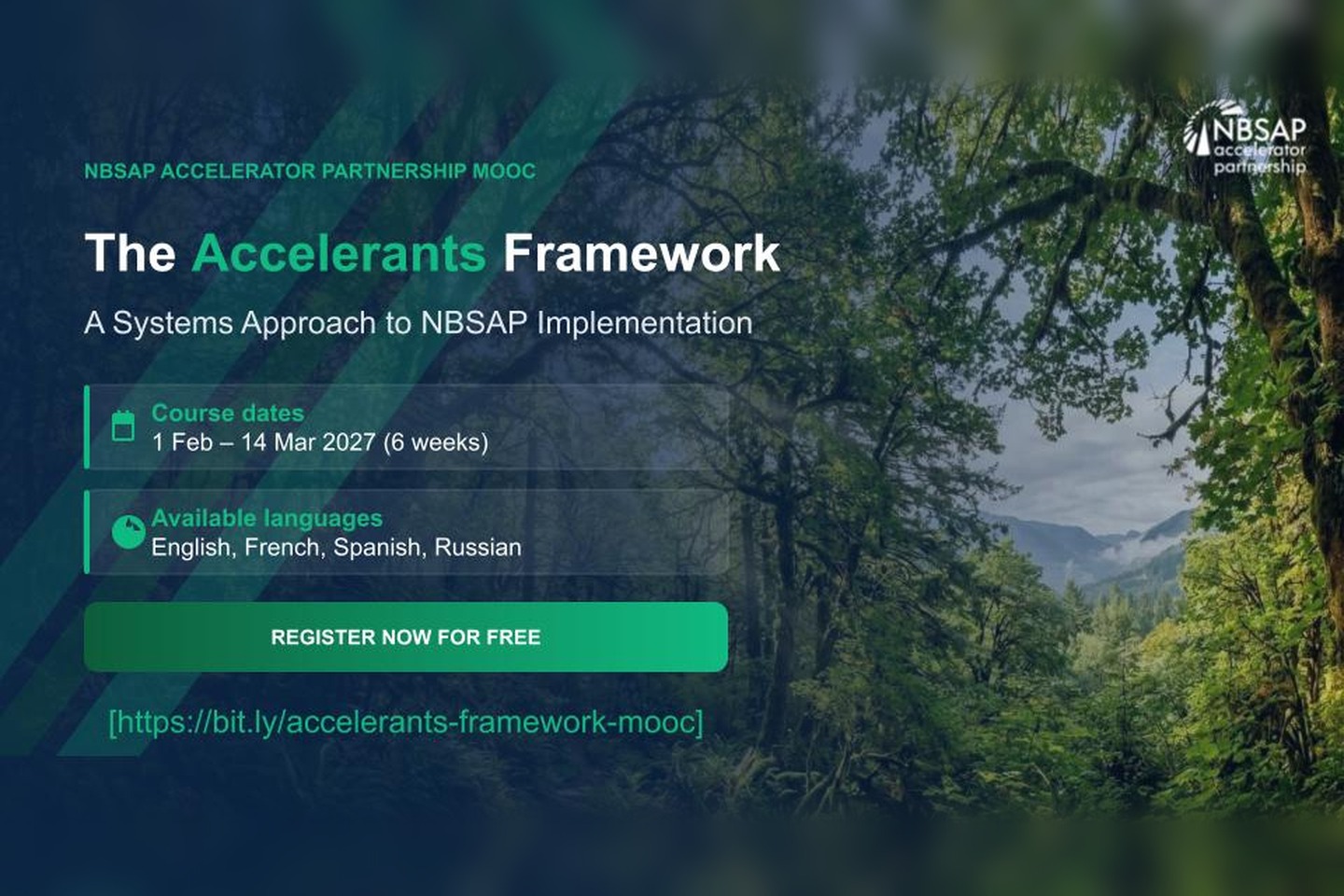
The Accelerants Framework was featured on Acceleration Day, 27 October, at the GBF Pavilion. The limited edition is available online at https://nbsapaccelerator.org/accelerants-framework/. A free, six-week online course on the Framework, offered by the NBSAP Accelerator Partnership on the Learning for Nature platform, will run from 1 February to 14 March 2027: https://www.learningfornature.org/en/courses/the-accelerants-framework-a-systems-approach-to-nbsap-implementation/
Notes to editors:
About the Accelerants Framework. The Accelerants Framework: A systems approach to NBSAP implementation is a limited edition printed for the launch at CBD COP17. It is not an official publication of the host organizations, and a final official version will be published at a later date.
Suggested citation: NBSAP Accelerator Partnership (2026). The Accelerants Framework: A systems approach to NBSAP implementation. Limited edition for CBD COP17.
About the NBSAP Accelerator Partnership. The NBSAP Accelerator Partnership is a country-led initiative that supports NBSAP implementation to collectively achieve the goals and targets of the Kunming-Montreal Global Biodiversity Framework. Co-chaired by Colombia and Germany, it is supported by the governments of Germany, Norway, Canada and France, and implemented by a Global Coordination Unit hosted by UNEP, UNDP, and the Secretariat of the CBD.
Media contact: Diego Ochoa, Communications & Advocacy Lead, NBSAP Accelerator Partnership, Diego.Ochoa@UNDP.org
Journalists and partners are welcome to request an interview with Accelerator representatives in Yerevan.
The NBSAP Accelerator Partnership is a country-led initiative that supports the implementation of NBSAPs to collectively achieve the goals and targets of the Kunming-Montreal Global Biodiversity Framework. It is co-chaired by Colombia and Germany, supported by the governments of Germany, Norway, Canada and France, and coordinated by a Global Coordination Unit hosted by the Secretariat of the CBD, UNDP and UNEP.
The NBSAP Accelerator Partnership is a country-led initiative that supports the implementation of NBSAPs to collectively achieve the goals and targets of the Kunming-Montreal Global Biodiversity Framework. It is co-chaired by Colombia and Germany, supported by the governments of Germany, Norway, Canada and France, and coordinated by a Global Coordination Unit hosted by the Secretariat of the CBD, UNDP and UNEP.
Explore more news


Explore more news